
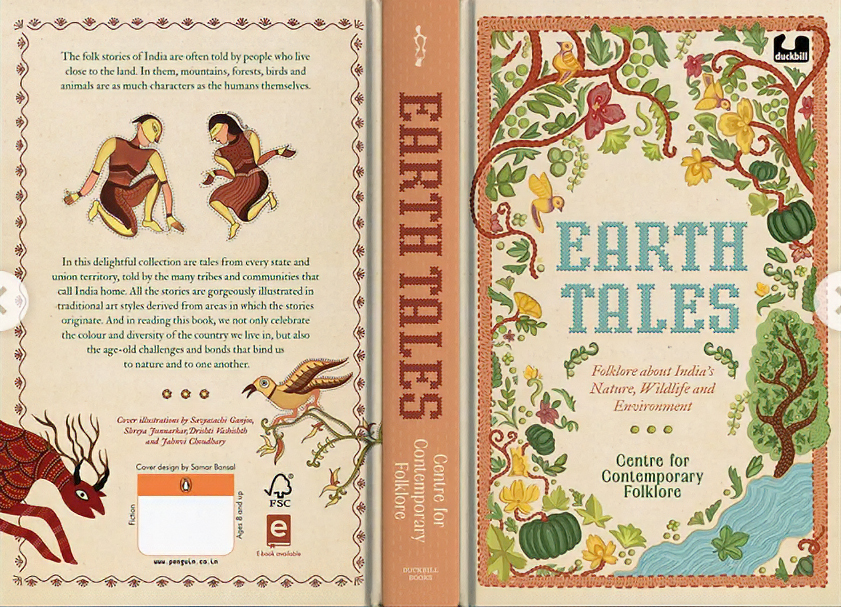
We live in strange times when every single human thought or action is driven by a strong urge to control rather than coexist with nature. Greed, overconsumption and exploitation of natural resources have alarmingly superseded a sense of contentment, empathy and any meagre intent to preserve our environment. We need a firm reminder of the incontrovertible fact that in the grand scheme of things in the universe, we human beings are not unsurpassable but extremely insignificant. And Earth Tales – Folklore about India’s Nature, Wildlife and Environment does this with a quiet charm.
Published by Duckbill Books, an imprint of Penguin Random House, in association with Centre for Contemporary Folklore, this collection takes us a step closer to our roots by highlighting our extraordinarily rich cultural heritage and story-telling traditions, both of which have evolved over time just like us humans. With thirty-six stories, one for each state and union territory of India, the collection not only celebrates the country’s vast geographical and socio-cultural diversity but highlights many environmental concerns it faces. From sun-kissed beaches and turquoise blue seas of Andaman and Lakshadweep to Araku Valley in Andhra, from mist-clad mountains in Arunachal to sand dune stretches speckled with khejri trees in Rajasthan, from mesmerising, heaven-like scape dotted with chinar and walnut trees in Kashmir to fertile plains of Punjab and mangroves in West Bengal, natural elements that define a region serve as central motifs in most stories. The local flora, fauna and nature spirits play a more prominent part than human beings. For instance, the Teesta River and kaafal berries are vital elements in tales from Sikkim and Uttarakhand. Why does the Mising tribe of Assam never kill gharials and dolphins? According to the Khasis of Meghalaya, how did lightning and thunder originate? Do you know some tribes in India write using Roman script? There are interesting questions and answers galore.
Tiger, the country’s national animal, makes its presence conspicuous by featuring in a couple of tales. From west to east, from Dadra Nagar Haveli, Daman and Diu, through Maharashtra, Madhya Pradesh unto West Bengal and Nagaland, the animal is feared and revered. Tales from Bihar and Punjab employ repetition as a storytelling device and sparrows as protagonists. A popular symbol of wit and resourcefulness, this little bird is nearly impossible to spot in cities today. The tale from Odisha is an excellent reminder of how avarice and over exploitation of resources spell doom. From giving rise to ancestors of the Jero tribe of Greater Andaman to adding colour to stories and imparting moral lessons, birds play a crucial role in many fables.
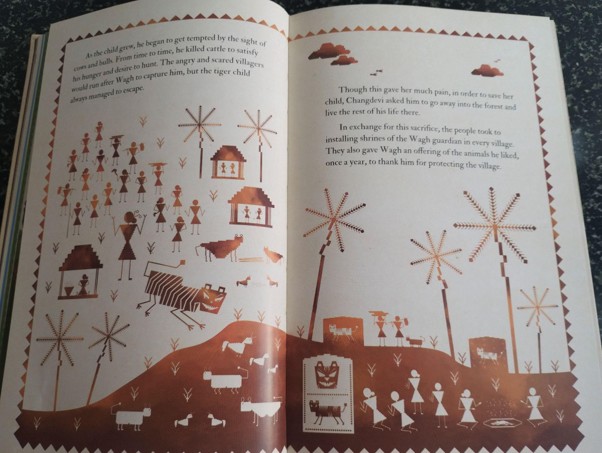
From the mighty tiger to a tiny flea, these stories show how every animal, big or small, is crucial to maintaining the ecological balance. Ram, Sita and Lakshman, the churning of the ocean and Mount Meru, the Kamadhenu (the cow of plenty) and Kalpavriksha (wishing tree) and a few Hindu mythological elements also find a place in stories here. Rendered in simple prose, revolving around animals, celestial bodies and nature spirits, these tales are not all ‘beyond-belief’ magic; they bundle ancient wisdom of several communities that exist beyond the realm of urban concrete jungles.
The true strength of the book lies in two aspects. Each story opens with an insightful introduction that provides information about the place and communities from which the tale originates. The language, script, beliefs and way of life of the community, along with the environmental crises in the region, are presented in crisp detail. Each story is also adorned by gorgeous illustrations inspired by the region’s folk art. These frame-worthy illustrations complement the text beautifully. Apart from focusing on our responsibilities in preserving nature, the collection is an earnest attempt at preserving age-old stories and various forms of folk art. With illustrations of Kalamkari, Gond, Pattachitra, Pithora, Phulkari, Thangka, Warli and various folk art or textile styles, the book is a mini art emporium.
That Uttara Kannada is erroneously translated as Southern Karnataka in a tale is a niggle in an otherwise exemplary collection. A map of India with states and union territories and main motifs of related tales offers a visual summary. The introduction and afterword clearly spell the intent and scope of the collection. Inviting, informative and important for both young and old, Earth Tales leaves us humans grounded at its end.

Divya Shankar is a freelance writer and an avid reader with a soft corner for Indian literature, short stories, translated fiction and historical fiction genres. Her reviews have been published on Scroll and The Book Review. She reviews books on Instagram too at @divyashankar553

