An unfriendly reminder of the cataclysmic consequences of ever-sharp axes and blue monsters …
We believe we know all about deforestation. We know because it’s a detailed topic in our textbooks. Because it appears in the newspapers every day and it stares at us through our social media feed. We know because it is discussed in seminars with eminent personas.
But how much of it do we really know? Have we ever wondered where deforestation hotspots are or when trees get axed, for that matter?
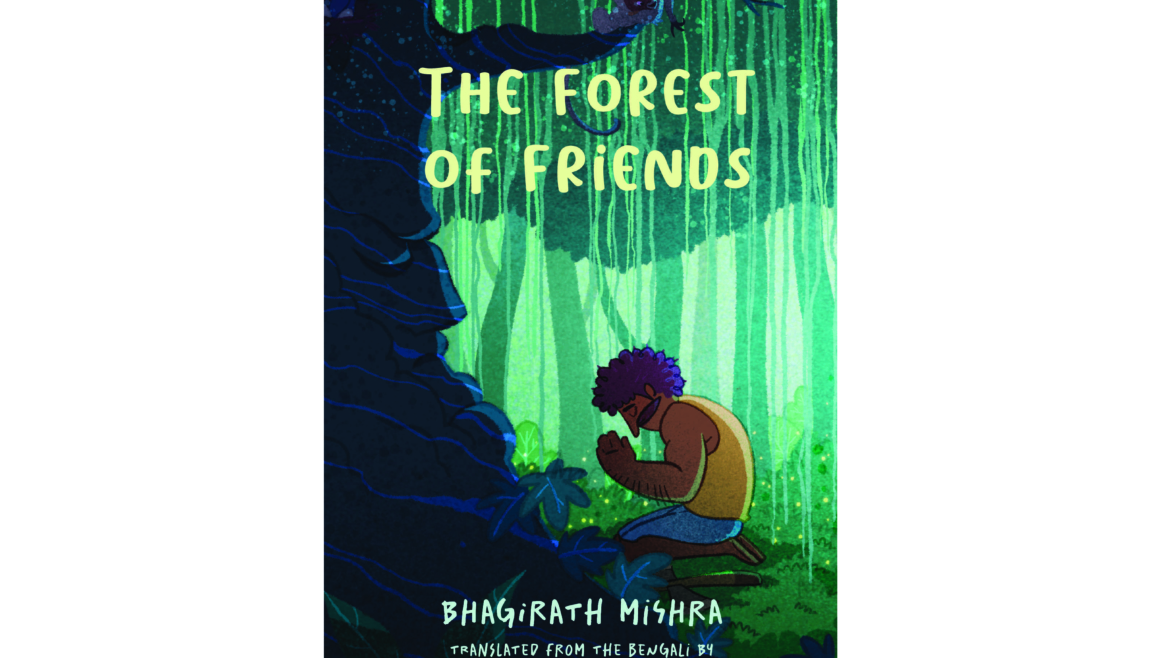
Bhagirath Mishra’s Madhubaner Bondhura, translated into English by Sohini Basak as The Forest of Friends, is a revelation into the thoughts, emotions and feelings of trees, animals, birds, and other natural residents of a majestic Madhuban forest, at a time when deforestation seemingly cannot cross any further limits.
When Paban Das, a powerful woodcutter with a gargantuan axe steps into the Madhuban forest, the neem, the kurchi, the shimul, the gulmohar and the mahua tree, among many others, shiver in silence. The trees of the forest are the very roots of all others in and around Madhuban. From tiny birds building nests in their nooks and crannies to the monkeys swinging through their long, twisted branches, and even the ancient River Kapil, whose water source is rain (summoned by the trees), everyone needs them.
But Paban Das acts swiftly, his mighty arms rapidly striking a deluge of blows on a new magnificent tree, almost every day. When the massive trunk falls, the spirit of the entire forest falls. Shivers of trepidation pass through each tree’s soft leaves; they wonder if they’d see the light of tomorrow, or if they’d be butchered and their skeleton would lie neatly stacked in a wood warehouse, carried away by monstrous blue tractors with gleaming yellow eyes.
The trees could easily ask their more powerful friends, the tigers, the bears, the elephants and the snakes, to end their problem for once and for all. But they are trees – they are givers, nurturers and protectors. Though they are wild, they are ethical. They must solve Paban Das’ ‘tree-rrorism’ while abiding by their unique code of conduct. Perhaps he too has a tree side, waiting within to pop out when nudged? Though even beyond Paban Das, who is merely a pawn in the grand chessboard of lumbering, other even more pressing issues remain for the forest.
As an author, I publish my thoughts on climate change frequently. I’ve often investigated linguistic means to reach readers in an era where climate change is being considered inevitable by the masses, and climate-change stories and news articles have become commonplace. And I noticed that The Forest of Friends’ emotive, melancholic descriptions of the axing of living trees would strike a chord in the heart of even the most unemotional person. The author uses a writing style where the narrative slows down and accentuates pivotal moments of tree-rrorism; this speaks to the heart of a human, another organism which feels pain, both physical and emotional.
There comes a moment in the book where Paban is exposed to the anthropomorphised characters of clouds and winds – this interaction bears an uncanny semblance to the ghosts of the classic ‘A Christmas Carol’ by Charles Dickens, the clouds and winds acting as eye-openers for Paban.
In my opinion, certain loopholes in the narrative arc exist. For example, the mobility of the trees for the roundtable discussions reduces the validity of them being rendered immobile when Paban Das arrives to axe them. The elaborate discussions and solution sessions between the beings of nature weaken the storyline to some extent due to their extended nature. Additionally, the character of the king of the forest is, arguably, inchoate.
However, the vivid poetic tunes you find every few pages, the plot twists, the introduction of new characters with dynamic personalities, and the resultant subconscious realisation of the nature and effects of deforestation make this book a fun and meaningful read for young readers aged 8 to 12. The writing picks up immense momentum by the latter part of the book (which, unfortunately, I cannot reveal!). To know more about the enchanting forest and its friends, and Paban Das, you must pick this one up!

Krishang Udasi, currently based in Nashik, enjoys reading newspapers, dreaming about design and chess, and listening to Alan Walker and Arijit Singh. He is the 2022 National Winner of FEE’s (Foundation for Environment Education) Young Reporters for the Environment competition and a passionate advocate of sustainable practices. It is his dream to impact education in our country by integrating design thinking, financial literacy, and environmental empathy. He believes that education for knowledge, not only for marks, is the best way to bring about environmental awareness and a positive change.