‘There are a few fundamental things one learns of rivers,’ author and journalist Sanjoy Hazarika tells in an interview to Samrat Choudhury (published in Frontline). ‘There is an entity far more powerful than you can conceive of and you must respect that.’ The people living in the lowland regions closer to the banks of Subarnarekha in Gold Sand Gold Water know this truth and consider themselves blessed to be touched by the river. The water is an intricate part of their lives; it gives and takes in equal measure.
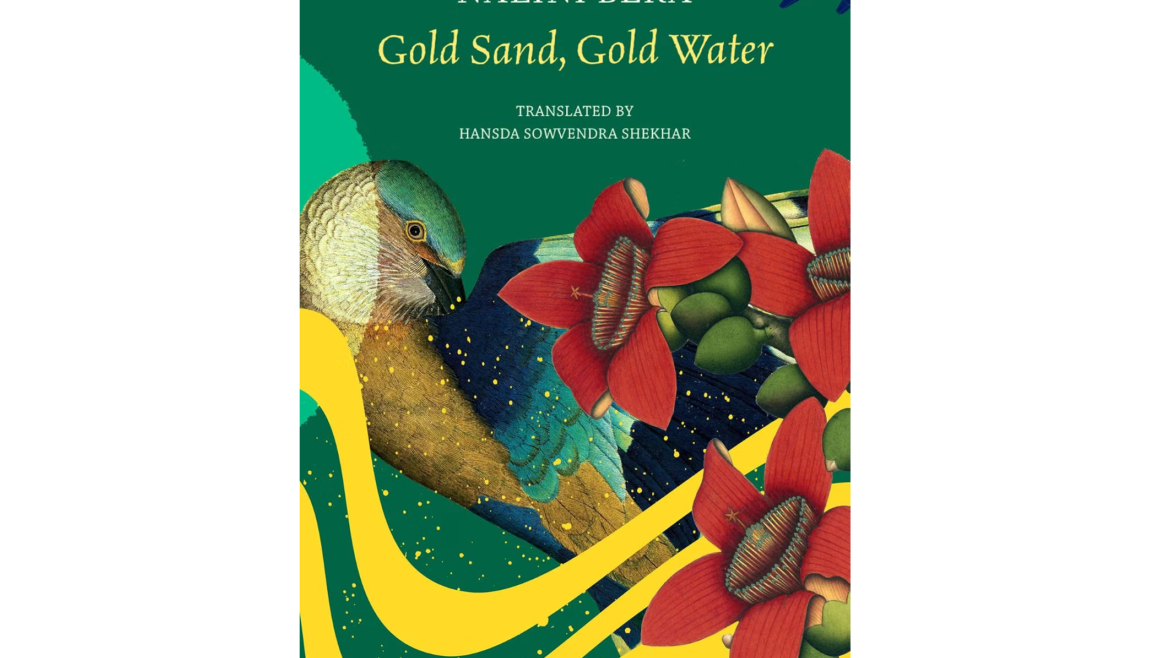
Translated from Nalini Bera’s award-winning Bengali novel, Subarnarenu Subarnarekha, Gold Sand Gold Water is an ode to the disappearing societies living along a river’s path. The narrator, Lolin, lives in Bachhurkhowal along with his large paternal family, belongs to the Hatua community and speaks the dialect. Anjanasundari, his paternal grandmother, introduces stories to him, exposing his imagination to the many realms possible. Lolin keeps returning to the river and is fascinated by the stories it carries. He dreams of travelling along the river’s course as far as the waters can take him. As a child, he wants to be an explorer and a deep bond with Hansi Nauria, the boatman, is inevitable with a dream like that.
In the narrator’s region of the river live several communities tied deeply to the land, namely Santhal, Kamar, Kumhar, Dom, Teli, Lodha, Raju, Mahato and several others. The boundaries, cultural and physical, are rigidly observed. When Lolin wanders to the village of the boatmen community, some of his classmates, girls, don’t acknowledge him, yet they share a deep camaraderie. So what if our nests are small? Our sky is vast—the lines from a song that echoes at the railway station in the final segment of the novel seem like a reflection of the villagers and their lives.
The Subarnarekha flows through forests and hills; it is rich with minerals and stories. None of the adults in the village seem to know how the river got its name, and Lolin’s search ends in the Puranas, a reference to the antiquity of the river. For all the communities living in proximity to the river, it is a lifeline. From birth to death, from washing clothes to watering fields, the river is a part of their journey, a silent witness, an omnipresent, omniscient being. ‘What if the flooded river took away all the saplings?’ Lolin’s uncle and head of their family is worried when the river rises after rice has been sown. ‘That was the tussle between the river and the humans who dwelt by it,’ Lolin pitches in.
In the boarding school that Lolin is sent to, the ripples follow, this time from the Dulung River and so do the tales. The lore associated with the river and the Bhramangarh fort, adjacent to the bank, is captivating.
For the Hatua people in the lowlands of Subarnarekha, lives change and they adapt according to the seasons; omens are carefully read, and rituals are followed; there is a subtle synchrony between their internal worlds and the one they inhabit, and despite the losses- big and small, their lives flow like the river in the vicinity.
With enticing folklore, rhythmic couplets and songs, Gold Sand Gold Water is a lyrical treat. Hansda’s prose in his body of work has found much acclaim, and in this book, as a translator, he brings the cadence of the original language. With interesting details of the flora, fauna and people and their occupations; languid afternoon scenes in the village, hens and goats that are a part of the family, the rice fields and games played by children on the banks, this deeply atmospheric novel transports the reader to the plains of Subarnarekha with its evocative imagery. This book excels in creating that sensory and psychological space. For me, The Subarnarekha will always remain the river where Lolin longed to explore and imagined himself as Gulliver.
There is a captivating synchronicity between the external and internal world of the characters. Just the way the river flows in its own madness, the currents within Chhoto Pishi’s mind move restlessly, erasing the islands between reality and imagination. Year after year, through winter, summer and the rains, as the river flows, what does it carry? Lolin asks. A reader understands that it carries minerals, bits of rock, silt that creates islands, and most of all, stories rooted in time, stories that look for safe banks as the people who safeguard them are dissipating.
Whatever happened in our lives, we had to include the river and the forest—they were as integral to our lives as our souls, Lolin tells towards the end of the novel. A reminder that people protesting to save rivers are not just fighting for water and livelihoods, but their own souls; a big part of their lives.
Rivers don’t remember history the way capital cities do, and I have been a witness to the most enticing stories a river (the one I have never seen) held.

Monisha Raman through her writing, both fiction and non-fiction, Monisha Raman aims to trace the unseen connections between people and the land. She is the author of The Highlands of Yore (Readomania, 2025), which is also forthcoming in the USA and Canada by Running Wild Press (June 2026). Her essays and short stories have appeared in various literary and ecological magazines.