
Hello dear readers!
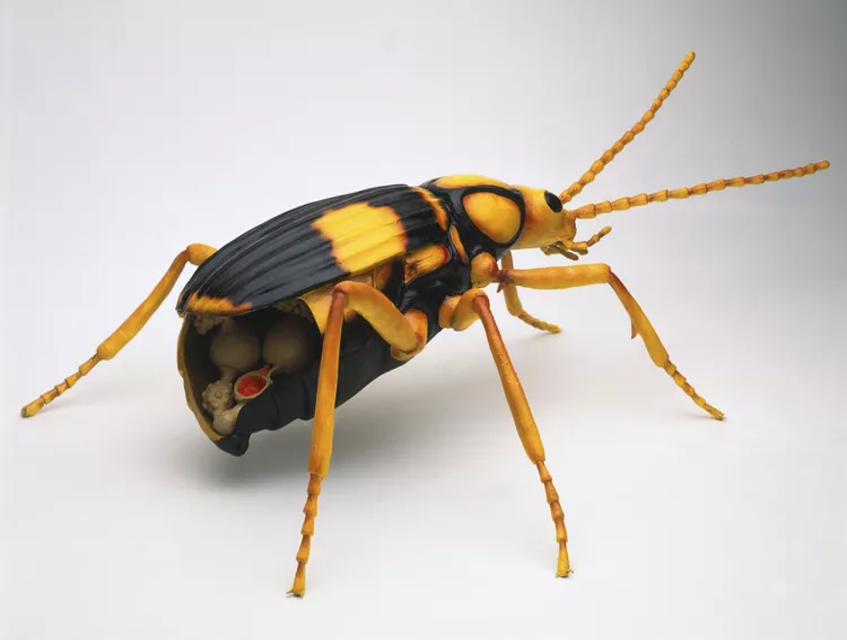
I’m Venus, the bombardier beetle, who captivated Rohan Chakravarty, author and illustrator of Carri-on Ruddy. Case 24 in his latest book is all about me and I must say that to suddenly be in the spotlight after hiding in plain sight for plenty of years feels a little disorienting.
You see, a part of my charm is that I have evolved to expel a searing, chemical mixture (as hot as your cup of tea) from my abdomen when disturbed or when a predator gets too ambitious. It is a lovely defence mechanism that has caught Sir David Attenborough’s eye and wonder too. My last noteworthy public appearance was in one of BBC Earth’s episodes with David commenting on my caustic capabilities.
I don’t really know why Homo sapiens are in awe of my scalding powers. After all, they’ve been doing it for millennia – by that I mean using heat in its various forms to their own advantage. The twist in the evolutionary tale is that they got a little ‘carri-ed’ away and heated up the planet in the process too.
Alright, my editor says that I have to take on a neutral tone when addressing human readers – they could be sensitive to my sarcasm.
Anyway, the pesky fellow, Ruddy is at it again. He continues to poke his mongoose nose into our business and has unwittingly created an audience that seems interested in what is just another day in our lives. Ok I’ll be honest – I’m enjoying the attention a little.
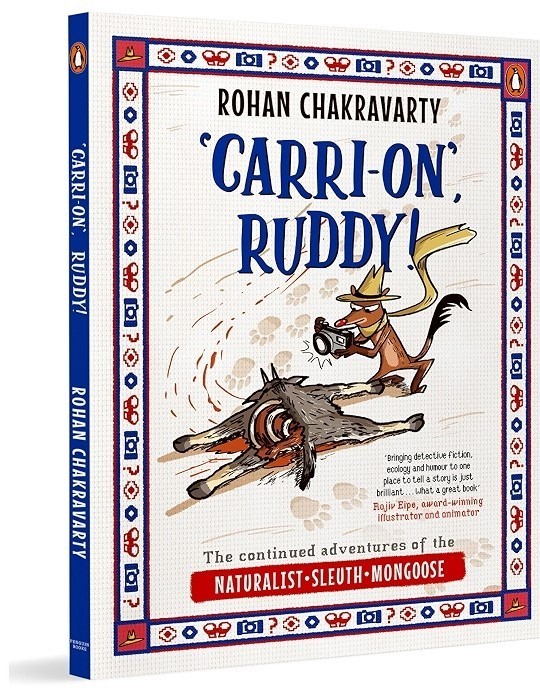
After his first book Naturalist Ruddy, Rohan Chakravarty comes back with volume two, Carri-on Ruddy, to sketch out various ‘crime’ scenes which are just natural interactions between us animals and our environments. A few of my mates are quite thrilled with the publicity. I suspect that most of them willingly came into Ruddy’s path and committed ‘crimes’ just so that they could get featured in the book. While most of Ruddy’s investigations are in his base location – Kanha National Park, he does take it upon himself to solve mysteries in other beautiful landscapes too, like the Western Ghats, the Sunderbans, a few wildlife sanctuaries and tiger reserves peppered across India, and some national parks including Namdapha, Bandipur, and India’s highest national park – Hemis.
Even though I’m a native of the wild, a few of his cases were news to me like how tadpoles of the Jerdon’s Tree Frog engage in ‘oophagy’ and how the Lichen Hunstman Spider holds lizards hostage! I also learned how to identify feathers of some birds of prey from Case 16 ‘Feather Frenzy’. In case you are also interested in learning about symbiotic relationships in the natural world, do read Case 22 ‘Anamalai Anomaly’, which records an interesting interaction between a tarantula and a frog.
Lorises, in general, arouse my curiosity too. The diet of the Bengal Slow Loris in Case 25 ‘A shot in the bark’ was informative to read. These nocturnal primates are difficult to spot – even more from my point of view at the ground – which is what makes them challenging to study. But with Ruddy and his escapades, we can be in the know. I, for one, am looking forward to his next adventures.
Now to the matter at hand. While Ruddy is the appointed mongoose detective for demystifying the happenings of our world, I would like to appoint a human detective to understand a few mysteries of the human world. I understand how keen Rohan is to be a Junior Detective but Ruddy has rejected him twice for valid reasons; therefore, I would like to offer the job to any other human who volunteers.
They will be tasked with finding answers to the following list of questions that baffle me:
- As primates (like apes, lorises, orangutans, and chimpanzees), humans used to be secondary consumers in the food chain. Why did they think moving to the level of apex predator would be beneficial for them?
- Gause’s law, otherwise known as the competitive exclusion principle, states that two species competing for the exact same limiting resources cannot stably coexist in the same environment. Are humans aware of this law – given that their numbers are increasing by the day with natural resources dwindling?
- What is the business continuity plan for the earth?
- Why do they destroy pristine landscapes and then make shoddy attempts to repair it later?
- Can humans survive on money? I’m very curious about this because it seems to be the only thing that most humans care about.
Interested detectives don’t have to necessarily make cartoon strips of these answers but there are points for trying. All the best!
Alright, I’ve to sign off now as it is lunchtime and Ruddy is visiting me for more information on Bombardier Beetles. He says it’s for a research paper but if he gets within sniffing distance of me, Rohan will have to look for another mongoose for the next book in the series. Tee-hee!
Hot regards,
Venus
Ps. Adding one more question to the list above. What on earth is ‘6-7’?

Lakshmi Ravinder Nair is a conservation writer on a mission to make environmental science and sustainability issues clear and relatable. Her articles have been featured in publications like Current Conservation, Journal of Threatened Taxa and SustainabilityNext. Through her background in content marketing, she uses fact-based storytelling to spark curiosity about the richness of our natural world and the importance of protecting it.